The space between visits
Live
Care is scheduled. Life isn’t. The 2 a.m. questions, the worry that won’t wait, the months with nothing on the calendar — this is what women text Phia in between, and it changes every time one of them writes.
Last text 3 hours ago · Updated October 8, 2026
Scroll
Every figure below comes from what women text Phia between visits and what they tell us when they join, set beside what the country knows about the year after birth. It refreshes on its own, so the numbers move as new texts arrive.
Key findings
- 40%of texts came after the six-week checkup — the last routine visit of pregnancy care.
- 42%of women who had given birth had not yet had a postpartum visit when they joined.
- 56%were living with at least one mood symptom when they joined. Mood and anxiety were the health worry women texted about most.
- 32%of texts arrived at night or on a weekend, when clinics are closed.
- 45%named at least one thing standing between them and care.
Chapter 1
The calendar ends at six weeks. She doesn’t.
Routine care is generous in pregnancy and sparse after it. Most women see a clinician every few weeks before birth, then once — at around six weeks — in the year that follows. If need tracked the calendar, texts would fall away after that checkup. They don’t.
Figure 1.1
Texts keep coming after routine care ends
Share of texts women sent Phia, by where they were in pregnancy or after birth when they wrote. Stages differ in length; “Week 13+” covers every week from then on.
In pregnancy, visits come every few weeks — and nearly two in five texts arrive in those months.
Routine care — prenatal visits, the birth, a checkup around six weeks
Nothing scheduled
And many women arrived having already missed the one postpartum visit they had.
40%
of texts came after the six-week checkup
38%
came during pregnancy, between appointments
42%
of new mothers hadn’t yet had a postpartum visit
The dip in weeks three to six reflects who has joined so far, not a quiet stretch: few women were in those weeks when they wrote.
Chapter 2
Who she is
The women here told us about their pregnancies, births and lives when they joined. Many are managing far more than a routine pregnancy: complications, surgical births, babies who needed intensive care, and very little sleep.
Figure 2.1
Health and life at a glance
Share of women, out of those who answered each question when they joined.
Covered by Medicaid
35%
Delivered by C-section
43%
Gestational diabetes
15%
Preeclampsia or HELLP
14%
Baby needed the NICU
24%
Sleeping five hours or less
47%
Describes her stress as high
26%
Feels unsupported
fewer than 11
The women Phia supports aren’t a random sample of U.S. mothers. Many women reach Phia through practices that care for higher-risk pregnancies, so read national figures as context rather than a controlled comparison.

Chapter 3
What she texts about
Every text is sorted by what she needs. Most of the time it is conversation — how she’s doing, what changed, what comes next — or the logistics of getting care. When it is a health worry, it is most often about her mood.
Figure 3.1
What texts are about
Share of all texts.
Figure 3.2
When it’s a health worry, it’s most often this
Share of texts that described a symptom or health concern.
32%
arrived at night or on a weekend
36%
of health worries were about mood or anxiety

Chapter 4
The mind
Mood and anxiety are the health worry women write about most, and where the gap in care is widest. More than half were already living with a mood symptom when they joined — and nearly half of those who had a child before had been through postpartum depression or anxiety.
Figure 4.1
Mental health when she joined
Share of women who answered.
Living with at least one mood symptom
Sadness, anxiety, intrusive thoughts or others she named
56%
Anxiety or panic attacks
28%
Intrusive thoughts
15%
Had postpartum depression or anxiety before
Of women who already had a child
48%
A self-reported symptom is not a diagnosis, and the national figure counts depressive symptoms specifically. The comparison shows how much more surfaces when someone asks.
Chapter 5
What’s in the way
Care she can’t get to isn’t care. 45% of women named at least one barrier — most often childcare, cost or insurance, or getting an appointment — and 30% asked for help with a need outside the clinic.
Figure 5.1
Barriers to care
Share of women who answered.
Too few women to show: language or culture.
Figure 5.2
Help women asked for
Share of all women.
Too few women to show: childcare, getting to appointments, safety at home, substance use support.
Chapter 6
When it’s serious
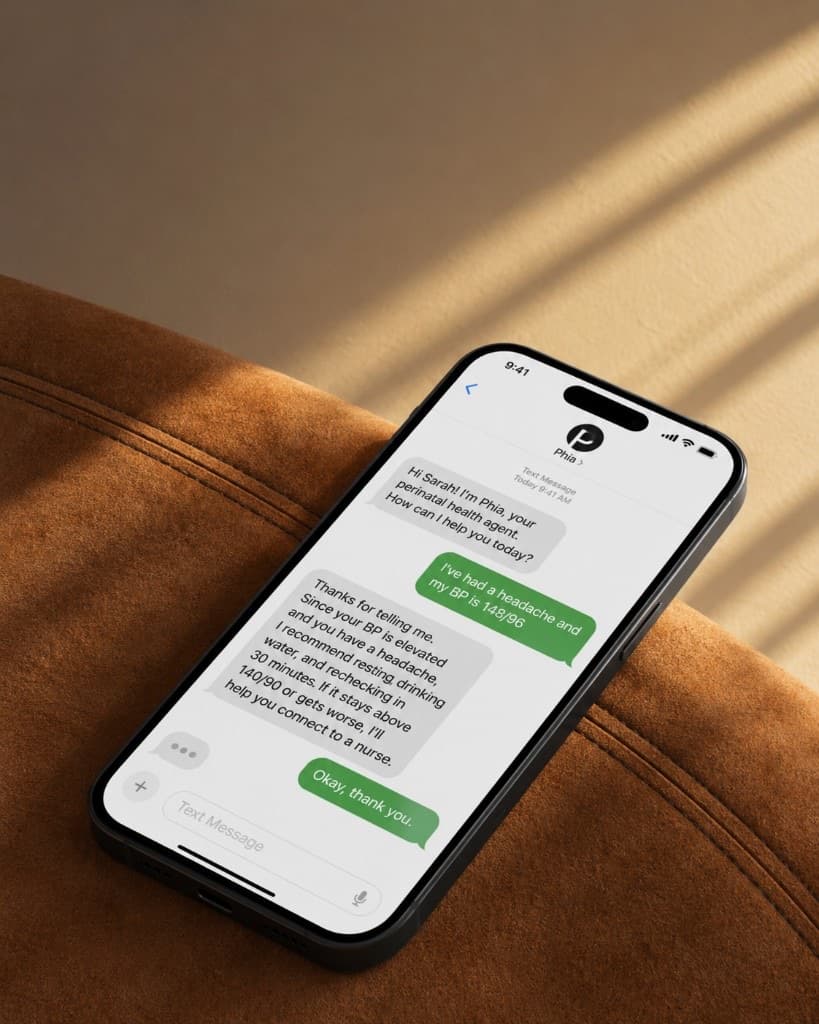
Most texts can wait for morning. Some can’t. Texts that describe an urgent warning sign — heavy bleeding, a severe headache with vision changes, chest pain — are flagged so the care team sees them first, whatever the hour. Texts that carry real distress, or that need someone to see her in person, are raised the same way.

About these numbers
- Drawn from the women Phia supports and the texts they send, with test and staff accounts removed. Shares about her health and life come from the questions she answers when she joins.
- Texts are sorted by topic and urgency, and placed by where she was in pregnancy or after birth.
- Small groups are never shown, and no text, name or location is ever published.
- The page updates from live data every 15 minutes.